The Sandman Saves Christmas

A campy good time awaits in this rare Kirby Christmas story!

Unusual Heroes: Dell's Dracula

Dell's Monster turned Superhero gimmick is campy fun.

Horror-Mood: On A Pale Horse

How would you like to have the Grim Reaper's job? Zane finds out!

Mystifying Marvels: Krull #1-2 (1983)

A forgotten 80's Sci-fi movie and it's forgotten comic adaptation!

DC Diversions: EKKO

Dr. Hawks dons the Ekko suit as murderballs and mayhem await!

Spotlight: Gene Day's Black Zeppelin

A plethora of hidden gems await in Day's dream anthology.

Unusual Heroes: Captain Zilog! #1

Ride the rails of insanely outdated computing technology with Captain Zilog!

Rockin' Bones #1

Monsters, Aliens and Punk Rockers...oh my!

Goin' Underground: Monolith

A couple of Larry's turn out an underrated comix gem.

Cult Classic Comics: Freakwave!

Get your Fog-Mask on, it's time to ride the Freakwave!

The Phenom of Phase

Fanzines never had this much firepower!

The Skull Killer

Pulp Fiction + Underground Comix = Classic

Saga of the Victims

70's exploitation at it's best.

The L.I.F.E. Brigade

Cheesy characters flourish within an underground art style.

Light Comitragies

A strange relic from the psychedelic era.

Monday, September 19, 2011

80's Oddities: Hugo #1 ( Fantagraphics, 1982)


Have you ever wondered what a Disney cartoon might look like if the artists were tripping on acid? Well here's your chance. Hugo #1 is the product of one Milton Knight Jr. This was Knight's first independent work, as he had previously worked as an illustrator for magazines such as Heavy Metal and High Times. He has since went on to become character designer for the 1992 animated film Cool World, and is still releasing work today.

According to Knight, he has always wanted to draw adult-style cartoons since he was a kid, after reading the underground comix of Manhattan in the seventies. He got his start in the comics industry writing scripts for Richie Rich comics at eight dollars per page. He then moved on to penciling for Marvel's Crazy series, and his artwork blossomed from there.

Hugo stars a little cat of the same name, who holds the job of Jester for the King of Rottingham. Set in medieval times, Hugo spends his time avoiding the evil Anarchist Brothers while vying for attention of Princess Trish, who carries a sex appeal similar to Jessica Rabbit. Make no mistake about it however, the similarities end there. These toons are all about getting drunk and high and having sex....often. When they aren't busy doing that, they are plotting murders and other criminal acts...or (if it can get worse than that) are subject to sexy demon zombie chicks from hell.


One such story in this issue has Hugo attempting to "get some" with Princess Trish, who is busy that night. Hugo goes up to his room plotting to get high and kill the pain of the rejection. A female feline taps at his window and to his surprise...she gives him the kind of attention he was after. It's a little weird seeing toons with huge breasts going at it, but Knight never takes it too far and remains tasteful for the most part.


Princess Trish catches Hugo in the act with the other gal, and plots to take the girl out when she comes out of Hugo's window. Curiously enough, the girl "flies" into the cemetery, where it is revealed that she is actually a zombie working for the Devil (who hopes to gain Hugo as his own Jester in Hell).

Trish falls down into their domain and is caught by a little demon, but she is able to escape. Her attempts to warn Hugo fail, and as he enjoys another night with the zombie girl, she reveals her true self...decayed breasts and all. Trish comes to the rescue by singing a song that drives the zombie mad, which triggers Hugo's love for the Princess and it's happily ever after in Rottingham.


Knight is one helluva good artist. He draws in that classic cartoon style that seems immediately familiar to the eye. But Knight's stories are completely off the wall and unlike any cartoon-style I've ever seen. He must have been smoking some good stuff to come up with some of these stories, but in any case...Hugo makes a name for itself as the oddest "Fairy Tales for Adults" the world has ever seen.

Saturday, September 17, 2011

Fanzine Fever: The Eye Special #1 (White House of Comics, 1965)


Don't be surprised if you've never heard of The Eye, or his creator Biljo White for that matter. White was a huge contributor to the Fanzine craze in the early Sixties, and created characters like "The Fog", "Astro Ace", and "Commando King" among many others. But "The Eye" was the most popular character of White's, and in 1965 the hero got his very own Fanzine special.

But more about that in a bit. It is important to note just how much comics meant to Biljo White. Collecting them since the 40's, White had amassed a huge collection of Golden Age comics including a near-complete run of Batman, which he stored in a building behind his house that he dubbed, "The White House of Comics".

As a huge fan of Gil Kane, White sent a letter to Kane asking him for advice on how to break into the comics industry. Not only did Kane reply with a nice three-page letter to White, but he also instructed him to take his portfolio to the DC Comics office in NYC. White did just that, but unfortunately was turned down. White had never been to art school, of which DC preferred. Still, that did not stop him from making his own comics.

The Eye Special #1 features the first adventure of The Eye that appeared in Star-Studded Comics #3, as well as some serialized strips that had run in the Voice of Comicdom fanzine. There is also a "Tom Trojan, Private Detective" backup story in this issue. White loaded The Eye with powers, as he has just about every cool power you can think of, from Burning Beams and Hypnosis to Mind-Probing and X-Ray Vision.


The first story portrays The Eye as a dangerous criminal working for the Mob. He supposedly "takes out" the Mob's enemies, but as the story continues he actually sets the Mob up at the right moment. He shoots a guy in the face with his "Burning Beam", but somehow it doesn't melt his face off. The Eye's greatest move is by taking out an overhead sprinkler system, drenching the Mob in water!


The next story is an espionage tale that begins when a USAF plane disappears behind the Iron Curtain. The Eye gets involved and captures a Russian thief, using his Hypnotic powers to interrogate him. That leads us to a showdown between The Eye and Voslov, the Russian villain.


White's artwork is very good considering he taught himself, and I was impressed with many of the layouts and panels used here. It would have been nice to see The Eye use more of his powers, but White did a great job incorporating stories he dreamt up while stationed in Germany during his military days. The Eye went on to appear in various comics perhaps in an ode to White, who passed on at the age of 73 in 2003.

Thursday, September 15, 2011

Just Plain Strange: In His Steps (Spire Christian Comics, 1977)


Spire Christian Comics have always been somewhat of an enigma among collectors in the comic world, and are sought after regardless of individual belief. That could be due to Al Hartley's eye-appealing artwork, or the strange fact that sex, drugs and violence are interwoven into Hartley's vision of the biblical parables he is portraying here. After all...this was the seventies.

Hartley made a name for himself drawing Patsy Walker "the prettiest girl in town!", a collaboration with Stan Lee in the late 50's in the hopes that more teenage girls would buy Marvel titles. Patsy would go on to become the heroine Hellcat in the 70's, and would also end up marrying the Son of Satan. I find this particularly interesting in that Hartley grew discontent with the material he was drawing for (like the Pussycat series), and became a born again Christian around this time.

With his newfound faith, Hartley looked for a publisher to create a new Christian comic series which would become Spire Christian Comics. Hartley was also working for Archie at the time, which allowed him to integrate Archie characters into the Spire line.

And in 1977 Hartley adapted In His Steps, a parable about a transient who walks into a church and dies while pleading to the Pastor about the lack of local Christian's good will, causing that Pastor to ask..."What Would Jesus Do?". The message hits church-goer Ed, who decides to end sexual advertisements in the local paper he runs.


Similar occurrences happen as other fellow church-goers begin to make their decisions based on the "What Would Jesus Do?" phrase. The pastor decides to spread his message at "the strip" which is full of XXX nude bars, drugs and strippers. A "tramp" attends one of the meetings and is prayed for, but runs out while a Christian pleads God's love for her. The stripper declares she is "Hooked on sex and drugs!" and "Let me go to Hell...the devil's waiting for me!". Surely every stripper must be thinking this...


But somehow the Christian woman is able to talk the stripper girl into coming home with her, and begins on a path to become a child of God. But at the next meeting out at the strip, an angry crowd (tired of the pastor's preaching) assembles and begins to throw bottles at him. A bottle hits the stripper girl and somehow she is killed. We never learn if she was saved in time, or if she went to hell!


The story skips on to the Christian followers continuing to follow the pastor's message, and as the years go by some are able to change for the better while others forget about the message and fall back into their evil ways. The story ends as one of the fallen Christian's tries to rob the pastor...then realizes who he is robbing and quickly regrets his actions and asks for forgiveness, causing the pastor to lead  him back to the strip where he now runs a Church conveniently located right next to the local peep shows.


Al Hartley's artwork has always been consistently good in each Spire comic, and that hasn't changed here. He draws a hilarious contrast between rich people driving Rolls Royce's and yachts while others are living in van's and whacked out on pills, beer and pot. While Hartley's artwork has good intentions, there is no denying the ironic plot points he instills within these parables.

I believe ultimately Hartley was attempting a scare-tactic in the hopes that the kids that read these comics would listen and become followers of God. And as said earlier, this was the seventies...so the content was a little more extreme based on what kids were being exposed to back then. Today, opinions on the Spire series vary...some readers are creeped out by them, while others feel they are a fun remembrance of their childhood. Regardless of opinion, they remain a little strange as far as Christian comics are concerned.


Tuesday, September 13, 2011

Science Addiction: Tales To Offend (Dark Horse, 1997)


At first glance, this issue of Tales To Offend #1 looks like it might have existed during EC Comics' science-fiction heyday, right along with Weird Fantasy. But this is not the case. Released by Dark Horse in 1997, this one-shot issue is actually the brainchild of a man named Frank Miller. Yep...the same man responsible for those amazing runs on titles like Daredevil, Batman and Sin City.

This comic is special in the fact that most fans of Miller's work don't even know that it exists, due to being released under very little fanfare. Tales to Offend features two stories (and one Sin City story, "Daddy's Little Girl") introducing titular space hero Lance Blastoff, who while not fooling around with Slutbots or barbecuing aliens for lunch is busy saving damsels in distress on a world full of ravaging Dinosaurs.

The first story kicks off with a female tour guide of sorts, leading a group of "tourists" around a world called the Dinosaur Planet. The tour guide speaks of a world without pollution or greed while huge dinosaurs hover nearby. A T-Rex suddenly chomps on the tourists right after the guide proclaims the dinos live in peace...


Enter Lance Blastoff to save the woman while she begs him to spare the killing of the hungry T-Rex. Not only does Blastoff "get off" on killing the beastie, he quickly turns the woman into a dino-meat addict after she gets a whiff of fresh cooked T-Rex. The story ends as Blastoff proclaims, "Remember Kids! Eat Meat! And Lots of it! It's Nature's Perfect Food!"


The next story begins as the woman begs Blastoff to stay with her after a one-night stand. Having gotten what he wanted, Lance takes off and lets another Dinosaur "wine and dine" her...Miller really goes no holds barred with his hero's antics and nothing is held sacred. Personally I was never near offended enough (or at all) to understand the meaning behind this comic's title, but if someone looks closely enough it should be there.


Eventually Blastoff reaches his ship, the Starship Phallica...where his legion of "Slutbots" just happen to be waiting to vie for his attention. A distress call comes in from an alien ship, and Lance debates whether to ransack them for their alien weaponry or use the helpless aliens as food for his next Superbowl Party. The cuteness of the aliens wears on Blastoff though, and the story ends as Lance takes the aliens to the "Mall Planet" and sells them off as pets to happy families. Everyone is happy...except for the now lobotomized aliens.


This is a very lighthearted romp for Miller, and while the humor is tongue-in-cheek Miller is able to evoke through illustration a certain feel for the meaning of his stories. The style of the art and the dialogue resemble those early EC comics Miller is spoofing here, and feels like an ode to sci-fi writer/artist Wally Wood. This may be the only dose of science fiction Miller fans may get to see, so for that I would say Tales to Offend is well worth picking up.

Monday, September 12, 2011

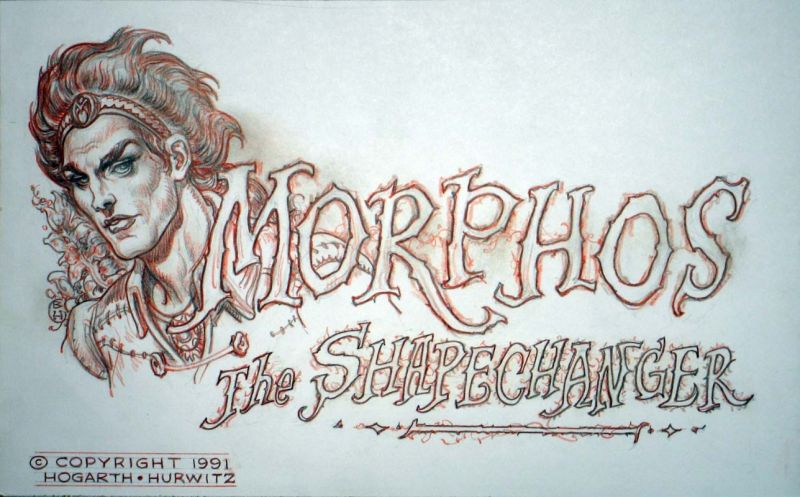
Unusual Heroes: Morphos The Shapechanger (Dark Horse, 1996)


Every once in a while I stumble upon a comic that simply blows my mind. Count Morphos The Shapechanger as one of them. Morphos is co-written and drawn by Burne Hogarth, an artist that I consider among the highest of echelons in the world of art. Known for his beautifully detailed Tarzan strips in the 30's and 40's, Hogarth went on to become a teacher in illustration, and his Dynamic series of textbooks were highly regarded as some of the best instructional art books a student could hope to get their hands on.

And in 1996 at 84 years old Hogarth was still drawing exceptional art. Together with long-time writing friend Harry Hurwitz, the two had planned to release a four-issue series featuring a complex story involving two scientist's quest for the evolution of man, with the help of the ghost of Merlin the sorcerer. But unfortunately Hogarth suffered a heart attack after completing the first issue and the series was never completed.

Dark Horse released the first issue later that year, including the rest of the story script and extra Hogarth illustrations that would have been used in the forthcoming series. What remains is a very interesting story with amazingly detailed, captivating artwork that will have you wishing for more.

The story begins with the tale of Merlin, the great wizard and advisor of King Arthur. Merlin gets trapped inside a Tower of Crystal after succumbing to devious treachery by the Lady of the Lake. Doomed to die entombed within the tower, Merlin's spirit has plenty of time to think about the evils of mankind and decides a change is in order.


Meanwhile, two scientists are traveling along the coast of Wales when they are involved in a car wreck. Dr. Kyra Reynolds falls down into a crystal cavern where she meets with the spirit of Merlin, whom entrusts her with a special crystal. As time goes by the two scientists learn that a hair within the crystal might lead to acceleration of the natural selection process...leading to a new species ten-times the brilliance of man.


They begin several tests and are able to create new and advanced species. But controversy surrounds the project, as owners of Dyna-Gene discover what the scientists are hiding from them and wish to steal their work. Dr. Kyra threatens to destroy the notes containing their findings which buys them some time. But the Dyna-Gene owners grow impatient and break into the lab, discovering the scientist's selection of mutant oddities.


After an altercation involving Dyna-Gene and two advanced monkeys named Arnold and Phil, Dr. Kyra realizes the only way to save the project is to inject herself with the genetic syrum, causing a vison of Merlin to appear and announce the coming of Morphos, the forerunner of a new human species as herald of a new day. But Merlin departs with a warning...although Morphos will become a shapechanger, he is still human and thus subject to the same evils as man.


And that is the first and final issue of Morphos. I enjoyed the premise and found it very interesting, and while reading the rest of the story there was something definitely missing within the absence of Hogarth's artwork. The few early illustrations added to the remaining story are nice, and it is a glimpse of what could have been if the series had been completed. Still, this is Burne Hogarth's final work, and so it shall forever remain a testament to just how important his artwork was within the storytelling realm.

Thursday, September 8, 2011

80's Oddities: Love Fantasy #1 (Renegade Press, 1987)


Love Fantasy #1 is quite an odd comic...not only for it's content but also for the writer's involved in the issue. Drawn by Canadian artist Jacques Boivin (who also worked on the erotic comic "Melody" for Kitchen Sink Press), the comic is essentially about strange love encounters. What attracted me to this comic was the cover, which had me enthralled in that it reminded me of my own relationship: I love giant monster movies (huge Godzilla fan) while my wife is a book addict, and the Kindle I bought her last year has already consumed nearly 100 titles.

The first story in this book is titled "Check-Out Girl". It is written by Mike Baron, the creator of characters such as Nexus and Badger. It is weird seeing Baron in this format, but he was writing for Flash at the time...so maybe he needed to "run away" from that type of writing for a bit. His story here involves a man named Malcolm asking the check-out girl out for a date, and gets rejected. He goes back to work at a bank where he encounters the girl again...and this time she accepts a date and much more. It's a very straight-forward and simple story, and I wonder if it was based on Baron's own dating experiences.

Next up is "The Perfect Guy", which is written by Canadian Arn Saba. Nothing really special here, as we meet a single mother named Katy who is looking to spruce up her life, all while being subjugated to various banter by her daughter and maintenance man. She gets set up on a date by her boss and falls for the guy, but finds out he is married. More interesting than this story is the life of the writer. Creator of the Neil the Horse series, Arn Saba officially changed his name to Katherine Collins and became a woman in 1993. Then in 2005 she was deported under the USA Patriot act for "crimes of moral turpitude". In 2008 she fell ill to leukemia, but has since recovered.

The last story, written by Mark Shainblum, is titled "Royal Con Interlude". It's a tale of a comic writer named Conrad who meets the girl of his dreams at a comic book store. They fall in love and together create a comic called "Magicstone". The series is a hit, and they set up shop at a local comic convention...where the writer encounters a fan that happens to be the actual Magicstone character in the flesh. Check out a few pages of the story:


The story gets a little bit more risque from here, but we end up learning that Conrad is just fantasizing, and the real "Magicstone" is his girl Marcie.

Yep, this is weird stuff. They should have called this comic "Weird Love Fantasy" instead.

Wednesday, September 7, 2011

Unusual Heroes: Morlock 2001 #1 (Atlas Comics, 1975)


Atlas Comics came out with some pretty strange characters in the seventies, and out of all of them...
Morlock 2001 has to be the strangest by far. Written by Michael Fleisher (who had worked on Spectre and Jonah Hex) and penciled by Allen Milgrom (of Captain Marvel and Avengers fame), the story is about a future totalitarian government who finds a man growing inside a plant, whom they plan to use as a weapon against those who rebel.

In this future of 2001 the government in particular is pretty hilarious. They have "Thought Police" that go around killing people that aren't following the rules, which includes stashing books (which aren't allowed after the great book burning of the eighties!) or talking about subjects like truth and freedom. They infiltrate a greenhouse of a scientist conducting "illegal botanical experiments" and kill him...taking his precious plant pods along the way.


They take the pods to a top secret laboratory for observation. There the regime's scientists discover that there is a man growing inside one of the pods...and he's attached to the inside of the pod "just like a pea or a bean!".


They rejuvenate the man and after they discover he can speak (apparently his fibro-cellular structure was pre-programmed) he is subjugated to a series of examinations brainwashing in hopes that he will follow their every command...and basically kill whoever they desire. One of the government's doctrines is "To Spy on a Neighbor is a Citizen's Highest Duty!"


They name their new weapon Morlock, and once he is ready to go to work they learn that touching  him can be very bad, as it will cause the victim to mutate into a green fungus that spreads across the entire body...killing them as they become rooted to the ground in agonizing, plant-like posture. Hedging, anyone?

The regime sends Morlock out to basically just touch everyone that is pissing them off, causing rooted plant-people to sprout up around the city. Morlock's one pleasure is feeding birds, and he meets a woman while bird-feeding one day and befriends her. He tells her everything, and how he dislikes being told to kill people. But eventually, he finds out she is a spy for the government...and Morlock feels betrayed and apparently very hungry, as he turns into his true monstrous form and proceeds to eat the woman all up for a yummy treat. Awesome! I've always wanted to do that to a spy...


Morlock escapes the facility and somehow finds the laboratory of the scientist that created him, where he is able to learn his true purpose...and his one downfall, which is that if he turns into his plant form he is capable of commiting acts of "hideous evil"! Meanwhile, the evil totalitarian regime assembles an army to seek out and destroy the "alien life form who threatens the security of our happy society!".


And that is the first issue of Morlock 2001. I found it pretty entertaining and a lot different from normal superhero fare. It has some good seventies cheese, and Fleisher's future with it's book burnings and Thought Police is just hilarious. There is nothing very heroic about Morlock, at least in this first issue. I mean...he eats his love interest! Sure, she might have been a spy...but according to her, her intentions were good. It's a moment that I've never seen in a comic before, nor had expected.

The cover of this issue is a bit misleading, as we see Morlock battling a plant creature...that is essentially himself! I enjoyed this comic not only for it's cheesy bits but because it was just so off the wall, and I'll have to check out more issues from Morlock 2001 in the near future.

Doesn't Morlock 2001 and the Thought Police sound like a good band name?